Agentic AI: What Agents Are, How They Work, and Why Tools Matter
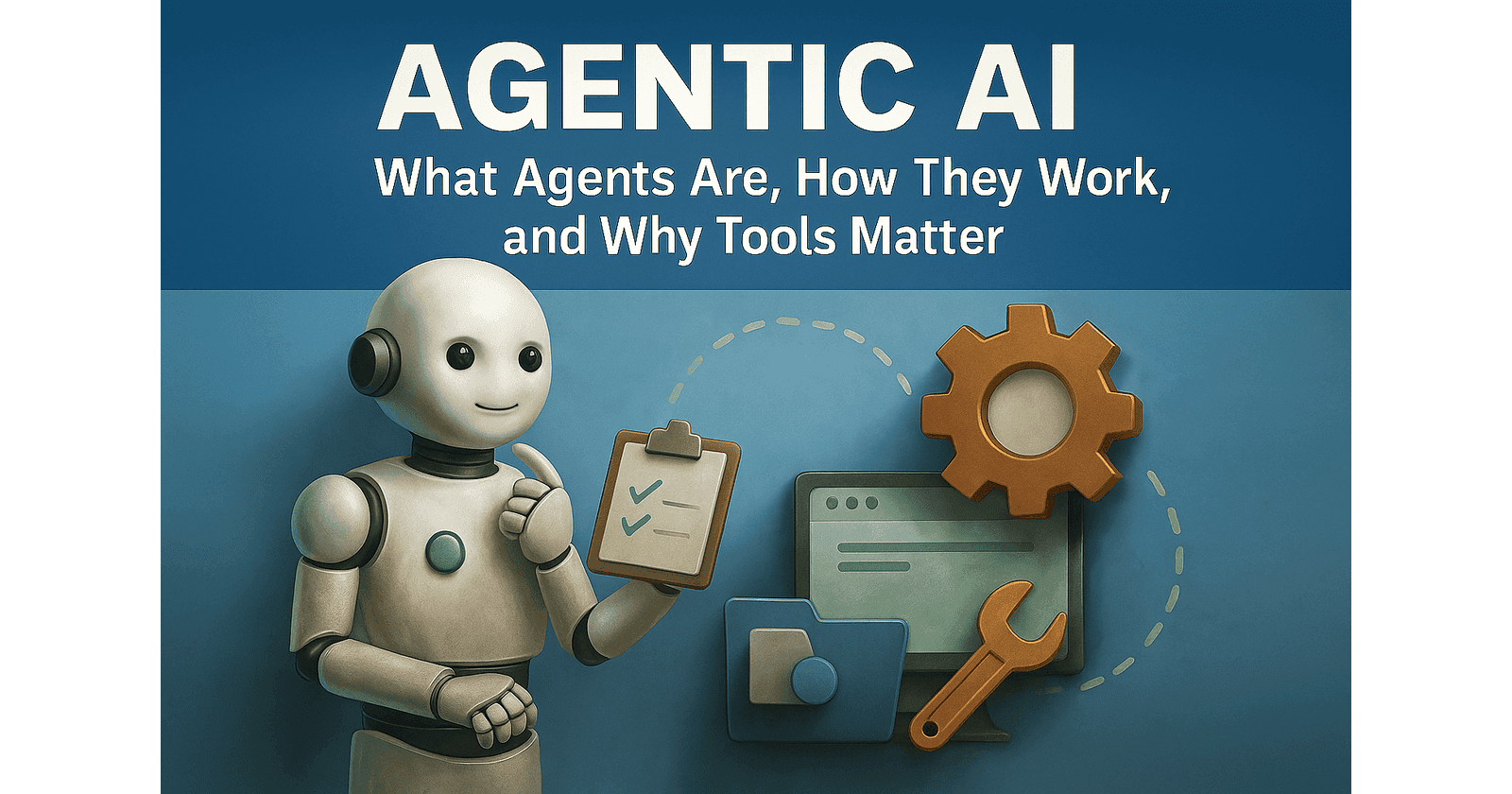
Why Agentic AI Matters: A Quick Hook
Imagine if your computer could not only answer your questions, but also help you schedule meetings, hunt down hard-to-find facts, or even finish your chores — all by following your goals! That’s the big idea behind agentic AI. These helpful digital tools are transforming the way we accomplish tasks, saving us time and mental energy.
Agentic AI isn’t just about fancy robots or futuristic dreams. Think of it as a practical helper that uses clever tools to carry out real-world tasks, one step at a time.
What Is an Agent?
Let’s break it down: an agent is an AI (artificial intelligence) programmed to act on your behalf to reach a goal. Pause here: if "agent" sounds mysterious, let’s use an analogy. Picture an agent as your super-motivated intern. You give them a clear mission; they assess the situation, develop plans, utilize the resources or tools you provide, and report back with the results.
Or, for something even simpler, think of an agent as a smart to-do list that keeps doing things on your behalf until the job’s done — asking questions, checking the calendar, even sending emails, all without you having to lift a finger (besides giving those first instructions).
How Agents Work — The Big Picture
At a high level, agentic AI performs its job through a repeating loop: observe the situation, consider the options, select the tools, execute the action, and verify if the goal is achieved. This loop keeps spinning until the agent has what it needs.
Let’s zoom in on the main parts:
Goal: The end destination. What you want, like “book a meeting.”
Perception (Input): Information the agent gets. Emails, web searches, calendar data—anything it "sees."
Reasoning/Planning: Like making a to-do list. The agent breaks down the goal into steps. Should it email? Search? Wait?
Action (Output): Actually doing the thing — sending emails, clicking buttons, fetching search results.
And it repeats this plan-act-check process. Here’s a simple diagram:
User goal
   ↓
Agent thinks (plans/decides)
   ↓
The agent uses a tool
   ↓
Agent acts (sends output or changes something)
   ↓
Result (if not done, loop again)
A little like a chef: recipe (goal) → checks pantry (perception) → plans steps → uses tools (knife, oven) → cooks, tastes, repeats as needed!
The Agent Loop in Pseudocode
while not_done:
    get_perception()
    make_plan()
    use_tool()
    act_and_observe()
Tools: The Secret Sauce
Here’s the magic: agents aren’t impressive unless they can do things. And that’s where tools come in.
Tools are special helpers that let agents interact with the world outside themselves. Think of them as magical wands in an agent’s toolbox. The agent doesn’t know how to do everything — but with the right tools, it can get a lot done.
Common tools include:
APIs (short for Application Programming Interfaces): Doors into apps or services (like calendars, emails, weather, etc.)
Web browser: Reads and interacts with web pages.
Terminal: Runs commands, downloads files, moves data around.
Calculator: Crunches numbers quickly.
File access: Reads/writes files.
Databases: Look up lots of data fast.
Plugins: Extra mini-programs for special tasks.
What can an agent do with these? Let’s get concrete:
Mini-Example 1: Browser Tool The agent can use a web browser tool to read a news article, click links, or fill out a web form — just like a human surfing the net (but no coffee breaks).
Mini-Example 2: Terminal Tool: Need to zip some files or search for a keyword in a document? The agent uses a terminal tool to run those commands automatically.
Mini-Example 3: Calendar API The agent asks the Google Calendar tool, “What meetings are open at 3 PM?” It finds a slot, schedules it, and sends you — or someone else — an email Confirmation.
Without tools, an agent is a genius stuck in a windowless room; with tools, it’s a digital Swiss Army knife.
Example A: The Email-Scheduling Agent
Let’s walk through an everyday agent at work:
User Goal: “Please set up a meeting with Sam for next week after 2 PM.”
Agent Perception: Checks users’ and Sam’s Google Calendars for open slots.
Reasoning/Planning: Finds time slots that work. Decides which day is best.
Tools Used: Calendar API (to check and create events), Email API (to send an invite).
Steps:
Reads everyone’s availability.
Picks a slot (say, Thursday at 3 PM).
Schedules the event through the Calendar tool.
Sends both parties an email invite.
Checks if the event appears on both calendars; if not, loops back and tries again.
End result: You sip your chai, the AI gets the meeting booked, and Sam wonders why you’re suddenly so organized.
Example B: The Research & Summary Agent
This one’s a researcher in digital boots.
User Goal: “Get the main facts and sources from this long article about global warming.”
Agent Perception: Receives the article link.
Reasoning/Planning: Reads the whole page. Looks for key points, ignores ads or pop-ups.
Tools Used: Web browser tool (to read the article), summarizer tool (to condense main ideas), citation manager (to collect links for quotes).
Steps:
Navigates to the webpage and loads the content.
Finds paragraph text, images, and charts.
Uses its language skills to pick out important facts.
Summarizes into 3–5 key points in everyday words.
Collects the source URL and quotes for citations.
Returns a tidy summary with clickable links.
Next time your teacher says, “Back up every statement,” your agent’s got your back (and your bibliography).
Where Agentic AI Shines — and Where It Struggles
Strengths:
Can work quickly, patiently, and tirelessly.
Handles repetitive, multi-step tasks with ease.
Can juggle data from different places and tools.
Limitations:
Sometimes “hallucinates” — makes up facts it doesn’t know (watch out for imaginary meeting times or fake news).
Needs access to the right tools and clear instructions.
Can get stuck on poorly defined problems or miss subtle cues.
Safety is a work in progress; it might overstep if guardrails are missing.
In short, agentic AI is like a really fast, super-obedient intern who sometimes spaces out or gets overly creative with answers!
Responsible Design & Guardrails
Just because an agent can do a task doesn’t mean it should — or should do it without supervision.
Smart agent designers use:
Human-in-the-loop: Humans approve important actions or double-check results.
Permission checks: Agents must have the right to use a tool or access data.
Rate limits: Limits on how many emails or tasks are done per minute, to avoid spamming or overload.
Think of these as seat belts and speed limits for your digital helper.
Glossary
Agent: An AI or program that acts on goals, plans steps, uses tools, and does things for you.
Tool: Something (software or API) that an agent uses to do real-world tasks — like a browser, calendar, or calculator.
API: A software doorway that lets one program ask another to do something (“Hey Google Calendar, is Wednesday at 2 PM free?”).
Perception (Input): What an agent can see or hear — emails, web pages, files, and more.
Reasoning/Planning: The agent’s mental math; how it decides what to do next.
Human-in-the-loop: When a human supervises or approves the agent’s actions (think: you, standing over your helper’s shoulder).
How to Try This Yourself
Curious? You don’t need a PhD or a server farm! Start by building a simple scheduling bot: Use a starter script that calls the Google Calendar API to check your availability, lets you pick a slot, and sends out email invites. Or, try a script that visits a web page, grabs the text, and summarizes it using a large AI model.
With a bit of tinkering, you’ll see the agent loop in action and will be tweaking your own digital intern in no time.