How to Talk to AI: System Prompts & Prompting Types for Beginners
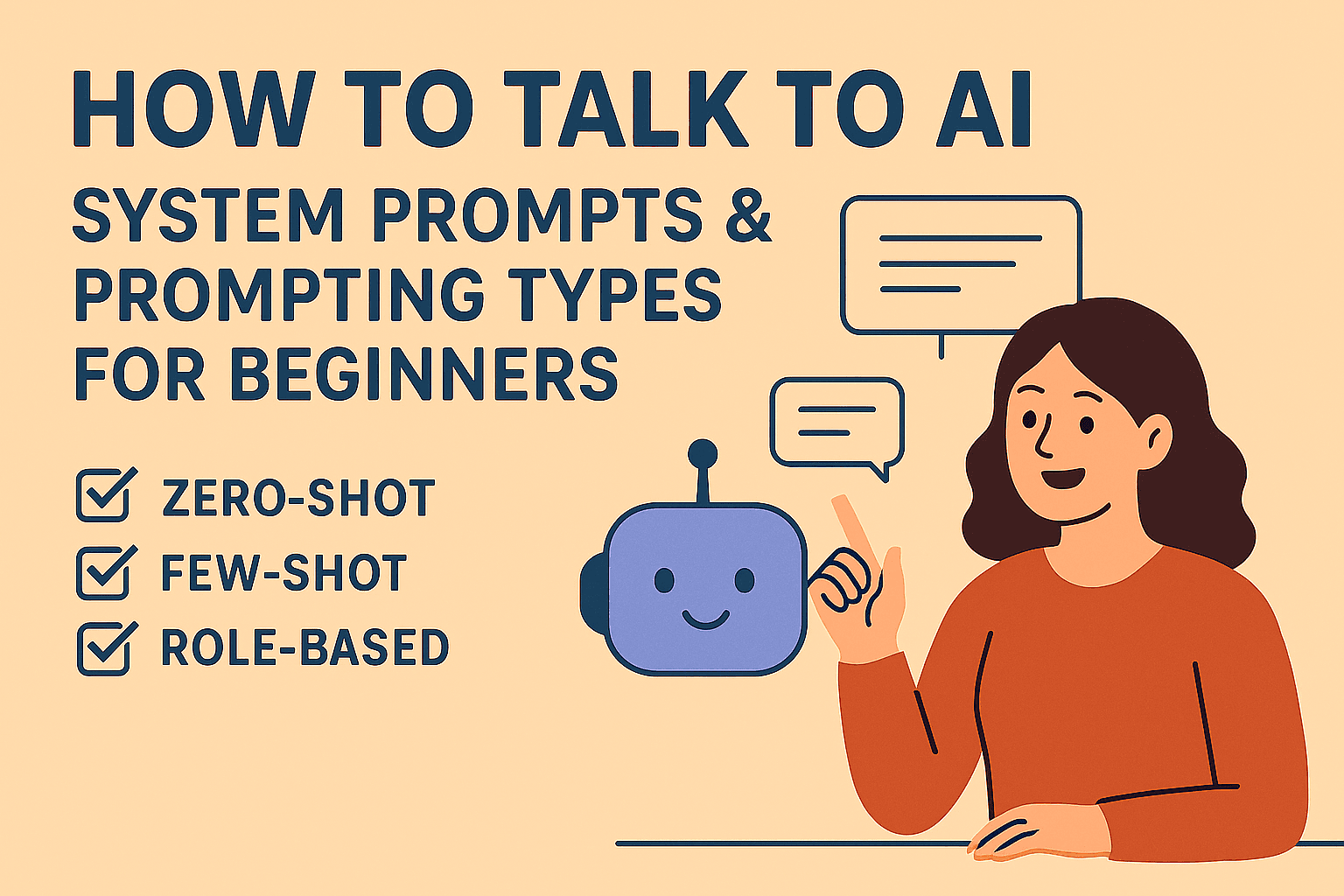
Ever asked ChatGPT something and got an answer that felt off — too formal, too vague, or not useful? You weren’t unlucky — you were under-prompting. The secret to consistently helpful responses from AI (artificial intelligence) isn’t asking more questions; it’s providing better instructions. This guide shows beginners how system prompts and the main prompting types (zero-shot, few-shot, chain-of-thought, role-based, and instruction + context) make AI replies predictable, useful, and on-point.
What is a System Prompt?
In chat-based models there are typically three roles: system, user, and assistant. A system prompt is the instruction placed in the system role — it’s the model’s job brief. It sets global behavior (tone, role, length limits, safety constraints) for everything that follows.
Think of it like hiring someone and giving them a job description before they start: it changes how they act every time they respond.
Example system prompt:
System: You are a friendly science teacher explaining complex topics simply for high-school students. Keep answers under 200 words and include one real-world example.
Then the user asks: Explain neural networks. The AI will respond in that friendly, concise teaching voice.
Why system prompts matter
Set the tone — professional, casual, or playful.
Keep focus — reduces wandering or irrelevant details.
Improve alignment — gets answers closer to what you actually need.
Save time — fewer follow-ups and clarifications.
Prompting Types — What They Are & When to Use Them
Different tasks benefit from different prompting styles. Here’s a compact guide with short examples.
| Type | What it is | Short example (input) | Best for |
| Zero-shot | Task only — no examples | Translate: "The cat is sleeping." | Simple, common tasks |
| Few-shot | Provide example input→output pairs first | Example: "Dog → Chien". Now translate: "Cat →" | Enforcing a specific format or style |
| Chain-of-thought | Ask for step-by-step reasoning before the answer | Show steps, then solve: 245 × 36 | Math, logic, planning |
| Role-based | Assign a role to guide tone/knowledge | You are a travel guide for Tokyo. | Expert-style or themed replies |
| Instruction + Context | Give a task plus background info | Summarize this article for beginners in 150 words: [paste article] | Personalized summaries or decisions |
Tip: Keep examples short and show exactly where the model’s output should begin — that reduces ambiguity.
Beginner’s Prompting Checklist
Before you hit send, run through this mini-checklist:
✅ Have I given the AI a role or tone?
✅ Is the task specific and constrained (length, format, audience)?
✅ Do I need examples to show the format I want?
✅ Should I ask for step-by-step reasoning?
✅ Did I paste any necessary context (article, data, previous answer)?
The better and clearer your prompt, the better the answer.
Prompt Recipes You Can Copy & Tweak
System + Role + Constraint
System: You are a friendly, concise explainer for non-technical readers.
User: Explain blockchain in 150 words with one everyday example.
Zero-shot
Translate into Spanish: "Where is the train station?"
Few-shot
Example: "He go to school." → "He goes to school."
Example: "They is happy." → "They are happy."
Now correct: "I walks home." →
Chain-of-thought
Please explain step-by-step how you solved this, then give the final answer: 245 × 36
Role-based (cooking example)
System: You are a professional chef writing for busy parents.
User: Suggest a healthy dinner for a family of four, ready in 30 minutes.
Instruction + Context
Summarize the following article for a beginner in under 150 words: [paste article here]
Common Mistakes & Quick Fixes
Too vague → Add constraints: length, tone, audience.
Model wanders → Set a system prompt and add “Answer only about X.”
Wrong format → Show 2–3 few-shot examples in the exact format you want.
Unexpected style → Add “Do not use technical jargon” or “Write like a friendly blogger.”
Debugging tip: Paste the model’s answer and ask it to “Fix these 3 issues” — faster than rewriting the whole prompt.
Accessibility & Ethics (Short Reminder)
System prompts shape behavior and can introduce bias. Use them responsibly: don’t instruct models to produce misinformation, violate privacy, or produce harmful content. Make prompts inclusive and clear for readers with different levels of knowledge.
Try This Now (Short CTA)
Copy any of the prompt recipes above, tweak the audience/tone, paste it into your chat, and iterate. See how the output changes — then try a few-shot version and compare. Share your favorite prompt in the comments and tell others what changed in the AI’s answer.