RAG Explained: How AI Gets a Library Card
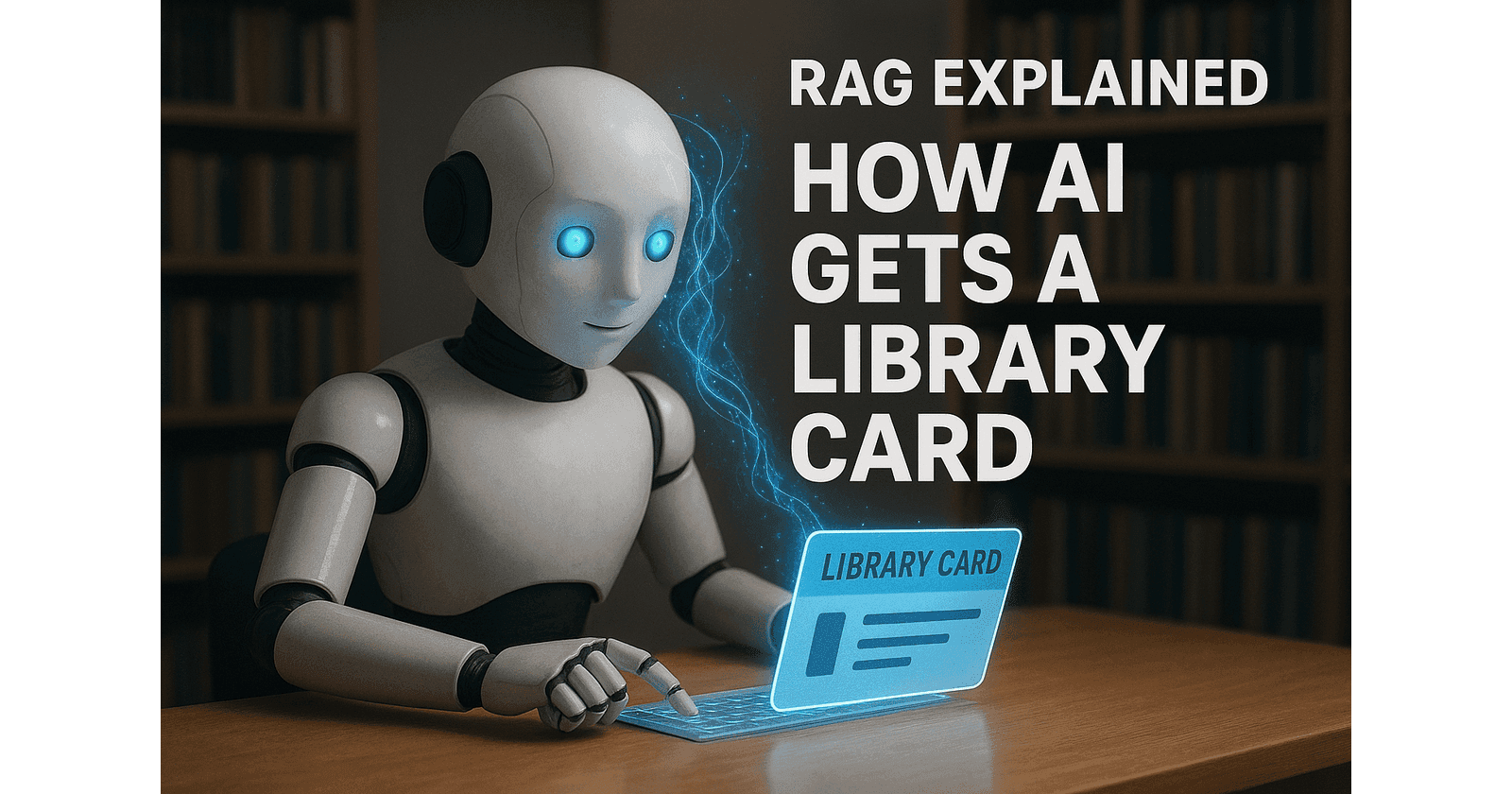
Okay, let's explore Retrieval Augmented Generation (RAG) together! It might sound a bit technical, but we can break it down into simple parts. Think of it like giving a super smart AI assistant a textbook to help it answer your questions better. 😊
What is Retrieval Augmented Generation?
First, let's see what it is. Imagine you have a brilliant friend (that's our AI generator) who knows a lot but doesn't remember every single detail. Now, imagine you also give your friend access to a well-organized library (that's our retrieval system). When you ask a question, your friend first looks up relevant information in the library and then uses that information to give you a more accurate and detailed answer. That's the basic idea behind Retrieval Augmented Generation!
So, what is it? Retrieval Augmented Generation (RAG) is a way to enhance the knowledge of large language models (LLMs) by allowing them to access and incorporate information from external sources when generating responses.
Why is RAG Used?
Now, why is it used?
To improve accuracy: LLMs are trained on huge amounts of data, but this data has a cutoff point. RAG allows them to access up-to-date information and facts that might not be in their original training data, leading to more accurate answers.
To reduce hallucinations: Sometimes, LLMs might generate incorrect or nonsensical information (we call these “hallucinations”). By grounding their responses in retrieved evidence, RAG helps to minimize these.
To provide context and sources: RAG can help explain why an answer is correct by referencing the source documents it used. This builds trust and allows you to verify the information.
To handle domain-specific knowledge: If you're asking questions about a very specific topic (like your company's internal documents), you can feed that information into the retrieval system, allowing the LLM to answer questions accurately within that domain.
How Does It Work?
Let's look at how it works with a simple example. Imagine you ask an AI: “When was the latest T20 World Cup final played?”
Without RAG, the AI would rely solely on its training data. If its data isn't up-to-date, it might give you an incorrect answer or say it doesn't know.
With RAG, here's what happens:
Retriever: First, a component called the retriever takes your question (“When was the latest T20 World Cup final played?”) and searches through a collection of documents (like news articles, sports websites, etc.). It tries to find the documents that are most relevant to your question. Think of it like a librarian finding the right section in the library.
Generator: Once the retriever finds relevant documents (let's say it finds an article titled “Australia wins 2022 T20 World Cup Final”), this information is then passed to the generator (the LLM). The generator takes your original question and the retrieved information and uses both to construct an answer like: “The latest T20 World Cup final was played in 2022, and Australia won.”
See how the AI used the retrieved information to give a precise and informative answer?
What is Indexing?
Now, let's talk about indexing. Imagine our library. If all the books were just piled on the floor, it would take forever to find anything! Indexing is the process of organizing the documents in our collection so that the retriever can quickly and efficiently find the relevant ones. It's like creating a catalog for the library.
Why Do We Perform Vectorization?
To make the search process even smarter, we often convert our documents and the user's question into vectors. A vector is essentially a list of numbers that represents the meaning or context of the text. Similar pieces of text will have similar vectors (numbers that are close to each other). This allows the retriever to find documents that are semantically similar to the question, even if they don't use the exact same words. It's like understanding that “car” and “automobile” are related even though they are different words.
Why Do RAGs Exist?
As we touched on earlier, RAGs bridge the gap between the vast knowledge stored in LLMs and the need for up-to-date, accurate, and domain-specific information. They allow LLMs to be more reliable and adaptable to new information without having to be completely retrained every time something changes.
Why Do We Perform Chunking?
Large documents can be difficult for both the retriever and the generator to handle effectively. Chunking is the process of breaking down large documents into smaller, more manageable pieces called “chunks.” This makes it easier for the retriever to pinpoint the most relevant information and for the generator to process it within its context window (the amount of text it can consider at once). Think of it like reading a book chapter by chapter, instead of trying to read the whole thing at once.
Why is Overlapping Used in Chunking?
Finally, why is overlapping used in chunking? When we break a document into chunks, sometimes important information might be split between two adjacent chunks. To avoid missing this crucial context, we can use overlapping. This means that when we create chunks, we include a small portion of the previous and next chunks in the current chunk. This ensures that the model has a bit more context around the edges of each chunk and can better understand information that spans across chunk boundaries. Imagine you're cutting a long ribbon into pieces, and you make sure that each piece has a bit of the part you cut before and after – this helps you see the entire picture.